
Granite School District is committed to providing clear information about the proposed 2026–27 budget and property tax increase being considered by the Board of Education.
Utah lawmakers have made significant investments in public education in recent years, including increases in the value of the Weighted Pupil Unit (WPU), educator compensation, and funding for programs such as full-day kindergarten. We appreciate those investments and the Legislature’s continued commitment to Utah students.
At the same time, changes in enrollment, funding formulas, program appropriations, employee compensation and benefits, and other operating costs have created financial pressures unique to Granite School District. The following answers address some of the most common questions about the proposed budget and tax increase.
What mailer was sent to all district residents in July 2026?
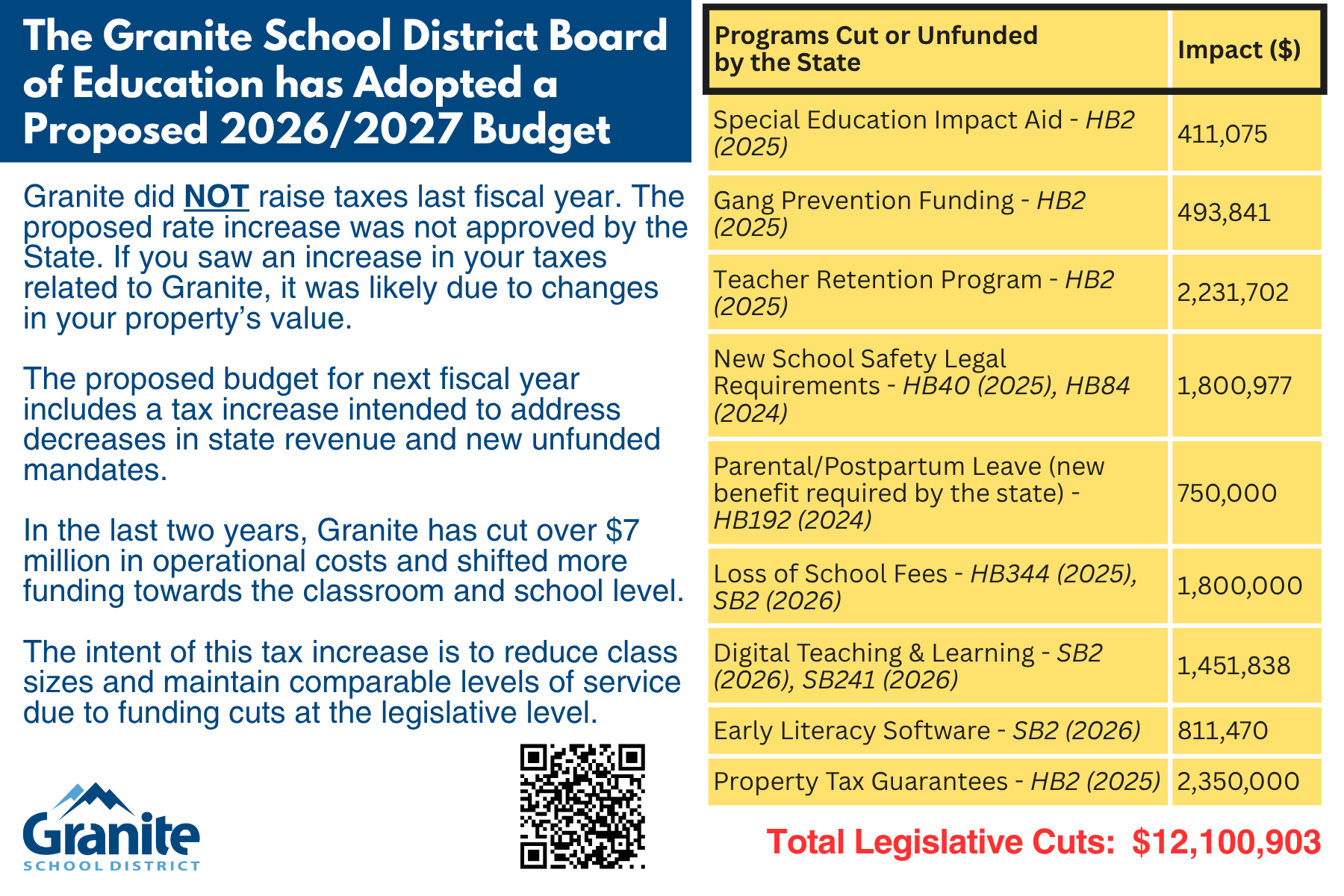
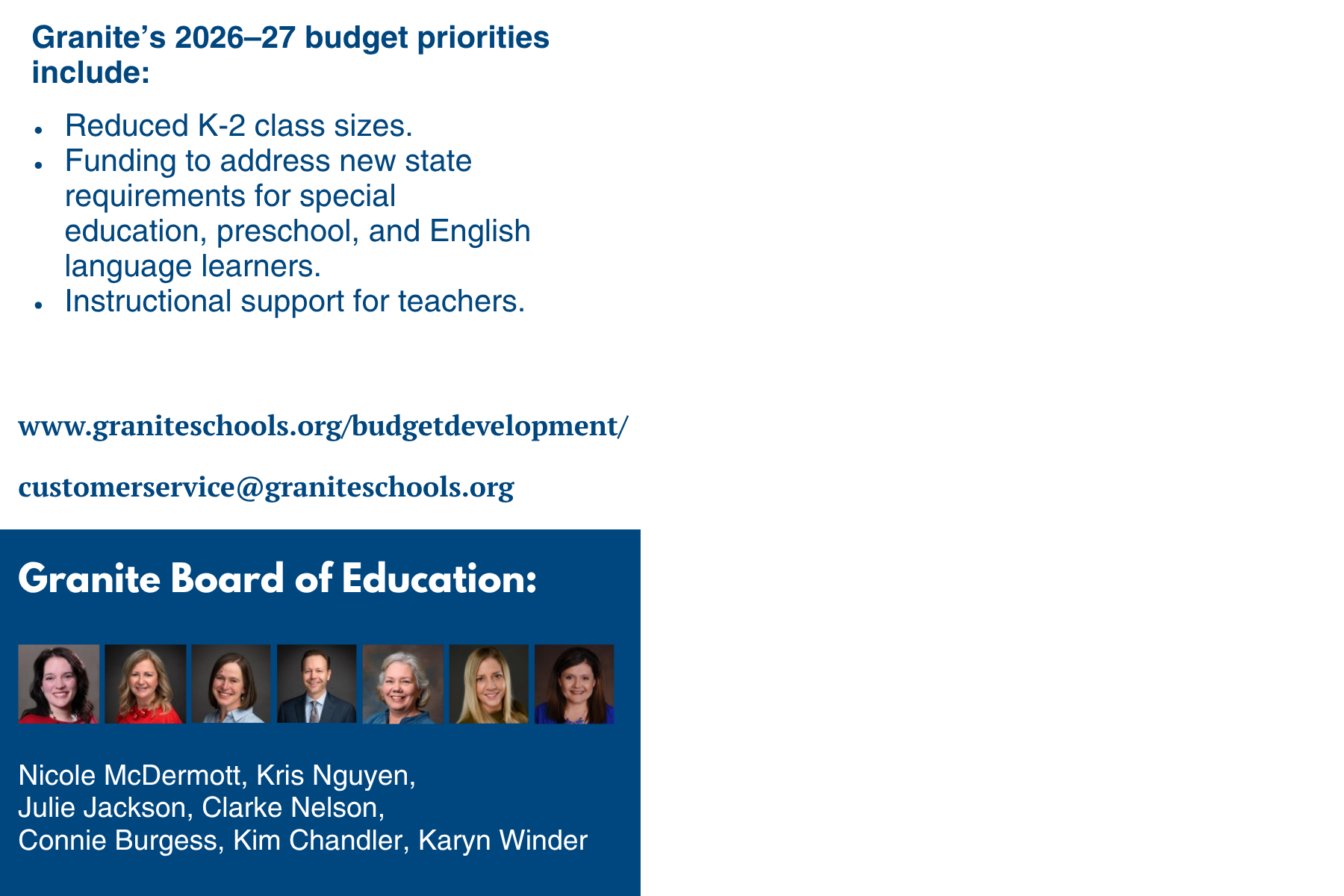
Where can I view the presentation file that was given at the August 18th Truth in Taxation Hearing?
Click here to view the presentation file.
Why is Granite considering a property tax increase when state funding for education has increased?
State funding for public education has increased significantly in recent years, and Granite has benefited from those investments. For example, the value of the WPU has increased, state support for educator compensation has grown substantially, and full-day kindergarten has brought additional state funding to the district.
However, not all state funding is available for general operating expenses. Some funding is restricted to specific purposes, and changes to state funding formulas can affect individual school districts differently. In several cases, statewide funding was maintained or reallocated, but changes in how those dollars were distributed resulted in a net funding loss for Granite.
The proposed property tax increase is intended to address those local impacts and maintain current levels of service for students.
If Granite has fewer students, shouldn’t the district need less money?
Declining enrollment does reduce some costs and state revenues, but school costs do not decline proportionally with every student who leaves.
Every school location still needs teachers, administrators, custodians, utilities, transportation, technology and other services even when enrollment declines by a relatively small number of students. Meaningful savings generally occur when enrollment declines enough to reduce staffing or consolidate and close schools.
Granite has already closed seven schools in the last decade and continues to evaluate enrollment, staffing levels and school populations to make sure resources are used efficiently. We anticipate a full districtwide study in 2027 that is anticipated to make closure recommendations for additional savings.
What has Granite done to reduce spending before considering a tax increase?
This last spring, the district conducted a 5% budget-reduction exercise and examined our entire operations budget for efficiencies and potential savings. That process identified and implemented nearly $5 million in savings before the budget was balanced using a proposed property tax increase. In total, $7 million has been cut over the last two years and we continue to look for cost saving measures. It is important to understand that those cuts were tied to specific needs, and the district evaluated which needs were more critical and which needs would have to receive less funding.
Those fiscal reviews considered which employees and students would be affected, the consequences of reductions, the programs and outcomes that could be affected, and how proposed reductions aligned with the district’s strategic priorities and most critical needs.
The district will continue evaluating programs, staffing and facilities as enrollment and financial conditions change.
Haven’t state funding increases made up for these costs?
State investments have supported important priorities such as teacher compensation and full-day kindergarten.
However, an increase in total state revenue does not mean all of those dollars are available to address every district expense. Some state dollars are restricted to particular programs, while other increases are associated with specific obligations or purposes.
In addition, changes to state distribution formulas can affect districts differently. Granite’s size, enrollment trends and local tax circumstances mean that some statewide funding changes have resulted in reductions in revenue available to Granite even when overall statewide education funding increased.
What state funding changes have affected Granite?
Several different types of changes have affected the district. They should not all be characterized the same way.
Some programs experienced direct funding reductions or elimination. In other cases, funding was moved to another program or distribution formula. Some formula changes maintained funding statewide but changed how dollars were distributed among school districts and charter schools. Other legislative changes created additional financial obligations for districts.
The important issue for Granite’s budget is the local financial impact of those changes, rather than simply whether total statewide education funding increased or decreased.
Some examples include:
- HB2 (2025), which decreased funding for Granite School District related to special education, gang prevention, teacher retention, and more.
- HB84 (2024) and HB40 (2025), which creates important but costly new school safety improvements for Granite School District, without providing adequate state funding to comply.
Why doesn’t Granite simply use increased WPU funding to cover these costs?
WPU increases provide important funding and flexibility, but those increases must also help cover rising employee compensation, health insurance and other operating costs.
For example, the district’s analysis of the 4.2% WPU increase shows that compensation and health insurance increases exceeded the additional flexible funding generated by that increase. In other words, while the increase in funding is appreciated, it did not keep up with our increased expense.
This is one reason an increase in the WPU does not necessarily translate into an equivalent amount of new discretionary funding available for additional programs or services.
How has the change in property tax guarantee funding affected Granite?
Changes to the state’s Voted and Board Local Levy guarantee formula shortened the period during which districts could receive certain hold-harmless protections (HB2 2025) (PDF).
Granite had historically spaced operational tax increases several years apart. The change in the state guarantee formula reduced anticipated state support to Granite by approximately $15 million over three years and creates an additional projected reduction of approximately $4 million in advance of next year’s budget.
Because districts have different property values and taxing circumstances, these changes do not affect every Utah school district in the same way.
Is the proposed tax increase primarily about reducing class sizes?
Maintaining appropriate class sizes is one component of the district’s budget planning, but the proposal addresses broader costs of maintaining current levels of services for students.
Declining enrollment by itself does not automatically produce smaller classes. Students are not distributed evenly across grades, schools and programs, and schools require minimum staffing levels to operate effectively.
The district continues to adjust staffing as enrollment changes and to consider school consolidations where enrollment declines make them appropriate.
Why not make deeper administrative cuts?
Granite continues to review administrative and support costs as part of its budget process. Granite also maintains some of the lowest administrative costs in the nation at less than 1% of its overall budget, so administrative reductions alone cannot address the budget challenge.
How does Granite decide which programs to keep, change or eliminate?
District administration and the Board of Education evaluate programs in the context of Granite’s strategic plan and its goals for students. The Board receives regular public updates regarding progress toward those goals and major district initiatives.
Budget reductions are also evaluated based on their effects on students, employees, services and measurable outcomes.
That review will continue as enrollment and available resources change.
What is Granite doing about declining enrollment?
Granite is actively adjusting its operations to reflect changing enrollment.
The district has closed schools as enrollment has declined and continues to evaluate staffing levels, school boundaries, facilities and future school closures or consolidations. It has also redesigned programs at several schools and expanded educational options intended to better meet community and student needs.
The goal is to align resources with the number and needs of students while maintaining strong educational opportunities throughout the district.
How is Granite working to remain competitive and prepare students for the future?
Granite continues to expand and adapt educational opportunities in response to changes in technology, industry and the workforce.
One example is the Granite Technical Institute, which works with industry partners to provide career and technical education opportunities. The district’s response notes that more than 3,000 high school students participate each semester across more than 50+ career pathways.
The district also continues to redesign schools and programs to better meet the needs and interests of students and families.
Where can taxpayers find more detailed budget information?
Granite publishes extensive financial, enrollment, staffing and budget information as part of its annual budget process. The district’s annual budget report includes information on revenue sources, property taxes, staffing, enrollment trends, fundraising, student fees, achievement data and long-term financial planning.
The final 2026–27 Annual Budget Report will be published following the August 18, 2026 tax hearing so that it reflects the Board’s final budget decisions.
How can the public provide input?
The Board of Education will hold a public hearing on the proposed property tax increase on August 18, 2026. The hearing provides an opportunity for residents to review the proposal, ask questions and provide feedback before the Board takes final action.
Additional budget information and required public notices are available on the Granite School District website.